The following report was written by Mike Garratt, CMILT - MDS Transmodal - Member of CILT (UK)'s Freight & Logistics Policy Group.
The transport world is very familiar with modelling, but the approach is normally quite different between the passenger and freight sectors.
Passenger modelling, with its familiar structure of trip generation, distribution, modal choice and assignment has been with us since the 1960s and has generally focused on optimizing the public sector’s provision of road networks and transit services, appraised from a public interest perspective. By contrast, freight modelling has generally been conducted at the company level where the objective is to optimize private sector supply chains’ unit costs and reliability and in order to maximize returns on the huge investments made privately in ports, terminals, distribution centres and mobile assets (HGVs, trains, terminals and ships etc.).
Public interest modelling for freight is more generally conducted to determine the demand made on road networks in the context of capacity analyses and not to optimize freight sector outcomes in the interest of the wider economy. One reason is that while typical motorized passenger journey lengths might be only 10 kms and therefore internal trips as modelled at the metropolitan level, which is the scale at which most major transport modelling exercises are conducted. By contrast, heavy freight lengths of haul in the UK have a mean length of over 100 kms meaning trip ends are often external to an urban study area and beyond local levers of influence such as land use planning.
However, freight modelling at the national scale has not been entirely ignored. MDS Transmodal (MDST) developed an initial version of its GB Freight Model (GBFM) 35 years ago to inform demand forecasts for the Channel Tunnel and the ferry services it competes with. Subsequently it was expanded to include all domestic heavy freight and calibrated against base year modal shares, port throughputs and road and rail network flows. It was employed by the then Strategic Rail Authority in 2001. The Department for Transport funded further upgrades to meet its requirement in 2004, while leaving ownership and responsibility for upkeep and updating with MDST. The wide range of public domain data inputs that feed the model (some maintained by the State and some by MDST) and facilitate its updating are also used to provide a quarterly monitoring service for Logistics UK which includes trends in trade through the ports, the growth in warehousing, shipping service capacity, trade volumes and in the use of the national road and rail networks.
GBFM has since been employed in studies and to provide modelled data for a wide range of interested parties including ports, sub-regional transport bodies, developers, National Highways, the National Infrastructure Commission, Network Rail, Logistics UK and the DfT itself. It has been used to help inform models in other countries and the European Commission. Examples of outputs from some of these projects are illustrated below.
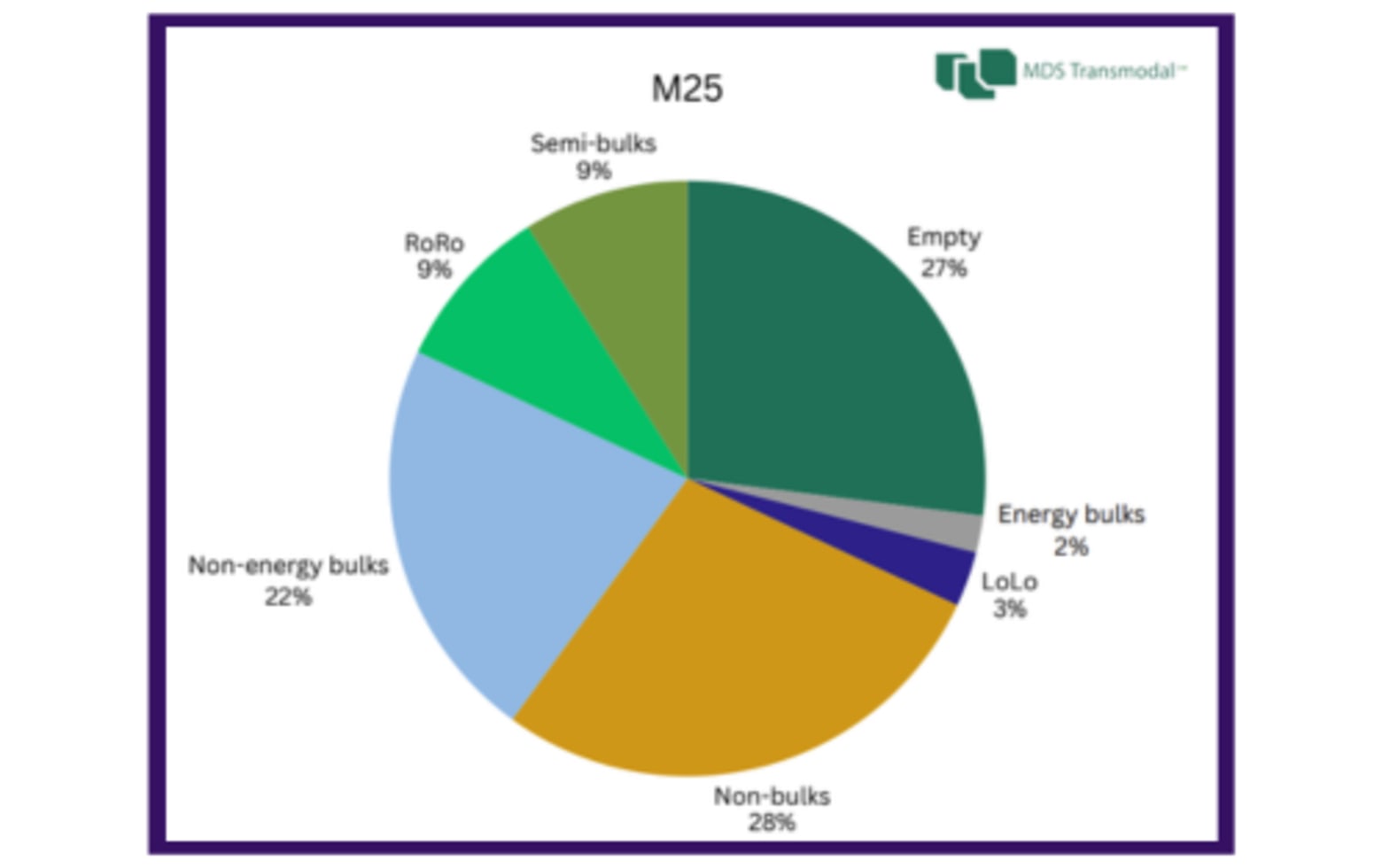


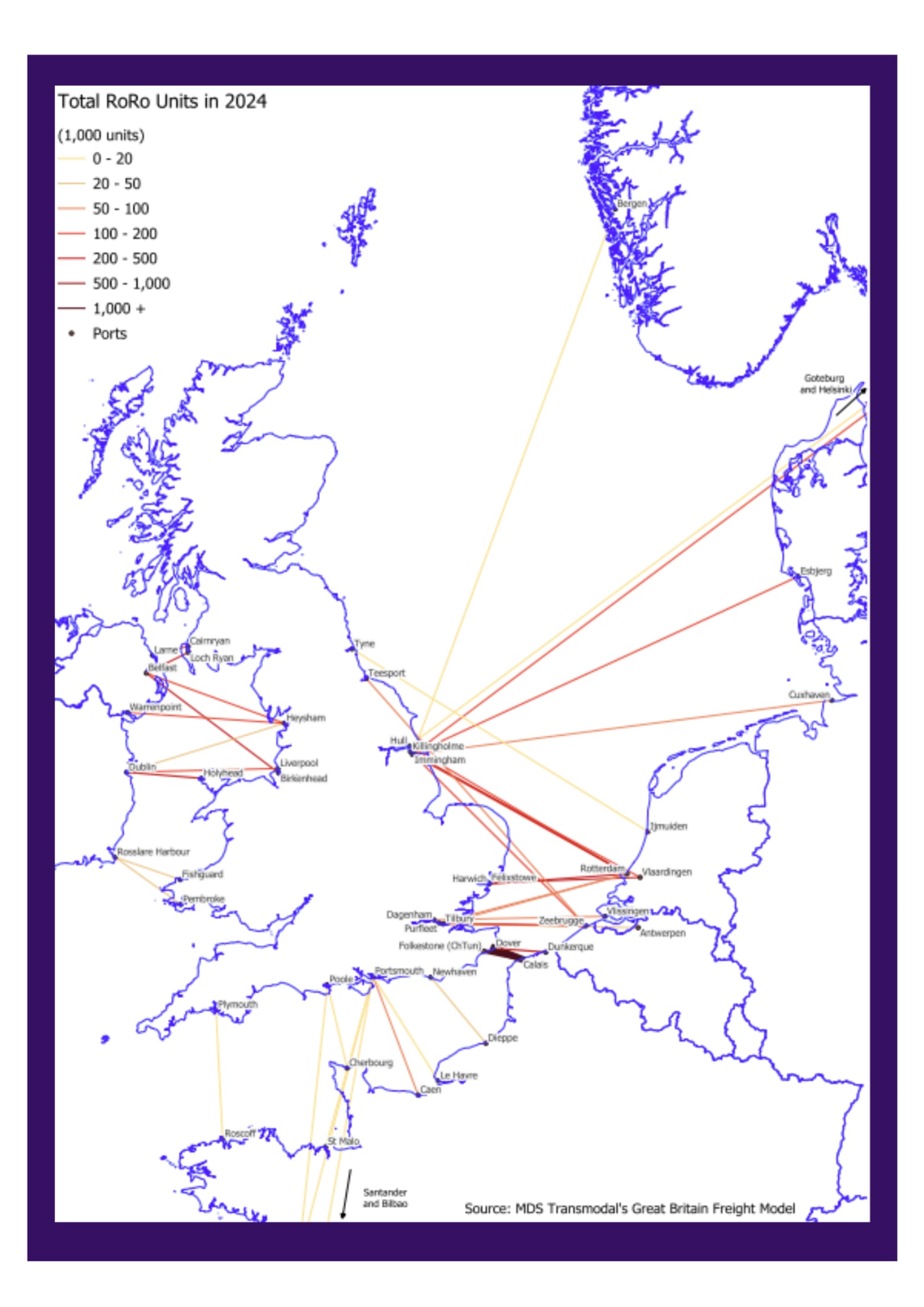

A ‘fixed’ freight matrix derived from GBFM was commissioned for the National Transport Model, but without active drivers that could inform policies. It provided the basis for the Government’s target growth rate of 75% by 2050 for rail freight during which a wide range of scenarios were tested and is currently employed developing detailed rail network capacity constrained rail freight forecasts for 2033/4 and 2038/9, considering a range of exogenous and endogenous impacts through scenario development. The model is calibrated to reflect current network loading and mode shares, can produce outputs by commodity (to reflect the relationship with the wider economy) and estimates the user and non-user benefits of policy or infrastructure interventions. That has included the impact of HS2 and East West Rail (in their various proposed formats) on the freight industry.
The model has been used to assess the role of the strategic road network by commodities carried, the impact of rail freight growth on network demand and to identify the links in the freight network that play the most strategic role.
Modelling at a national level offers a range of opportunities, which includes developing policies that address the relationship between warehouse clusters, road network capacity and the location of intermodal rail terminals, the distribution of aggregates from ‘super quarries’ by rail and road, the impact of inland infrastructure on the competitiveness of ports and the prize of raising mobile asset utilization by addressing points of freight congestion in the road network and improved rail freight train pathing. The switch towards electric traction re-introduces the prospect of road pricing and its potential impact on location choices, which GBFM was last employed to test 20 years ago.
The recent decision by the Department for Transport to commission their own and exclusive freight model provides an interesting step in raising the profile of freight and creates the opportunity for the different policy teams in the Department to coordinate activity through the use of its own model (to be known as FAME) and of the State provided related databases. If this leads to the State having a better appreciation of the role and requirements of the freight sector this has to be welcomed. It has published a feasibility study prepared by MDST that effectively describes the functionality of GBFM and shows how a model can be incorporated into policy development. The peer review published alongside recommends that this blueprint is (broadly) followed.
It is important to remind ourselves that the freight sector is not a centrally planned system but a market based on a complex trading environment in which individual companies make investments in assets to achieve competitive advantage. Change will not take place unless it is in the private interest of the market actors who invest in fixed mobile assets, and these interests have therefore also to be considered within the modelling framework. The value of these assets may be enhanced or diminished by the investments made by the public sector in its road and rail networks. One of the opportunities this initiative provides is for the private sector to make the case for investment in those networks in an informed and quantified way in the knowledge that the State will be able to run its model to determine its wider economic value. Modelling to take account of the wider impacts of an intervention may take the place of lobbying, strengthening the case of the freight sector in its relationship with the public sector.
A preliminary step could be to require models conducted at a metropolitan level to incorporate freight in such a way that national and local policies on land use and modal share are properly dealt with. This issue is currently being examined by CILT’s Freight and Logistics Policy Group (FLPG) which has established a working group on Freight Visibility and Value including modelling economic value across modes.